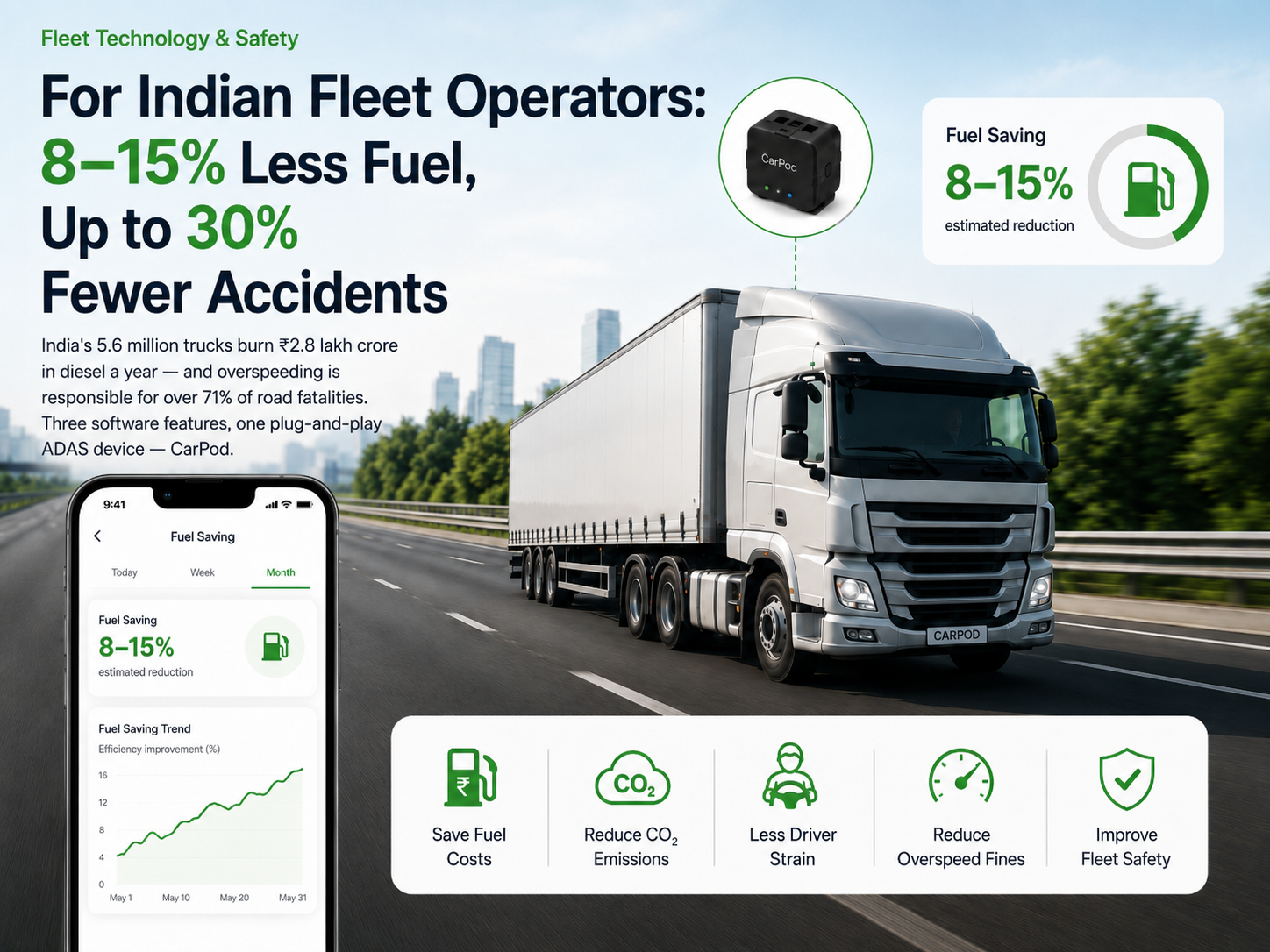
India's road freight network is the circulatory system of a USD 4.1 trillion economy. More than 60% of the country's freight moves by road, carried on 5.6 million trucks and buses that collectively burn an estimated ₹2.4–2.8 lakh crore in diesel every year. Fuel alone accounts for 40–45% of a fleet operator's total operating cost — the single largest controllable expense.
At the same time, India recorded 461,312 road accidents and 168,491 fatalities in 2022, according to MoRTH's Road Accidents in India 2022 report. The causal factor cited most often: overspeeding — responsible for 72.3% of accidents and 71.2% of deaths. Commercial vehicles are disproportionately involved in the worst of those incidents.[1]
The standard prescription — driver training — is effective but ephemeral. Research shows eco-driving gains decay within 90 days without continuous reinforcement.[2] OEM-embedded solutions help, but they only address new production: less than 8–10% of the total fleet per year. The other 5+ million vehicles on the road are left untouched.
"The only path to fleet-wide safety and efficiency impact at national scale, within the 2026–2028 regulatory window, is an aftermarket solution that works on vehicles already on the road."
That's exactly the problem the Aha CarPod was built to solve. The CarPod is an iCAT-certified, plug-and-play aftermarket module — installed behind the dashboard in under two hours, compatible with 150+ vehicle models from Tata Motors, Mahindra, VECV, SML Isuzu, and every other major Indian OEM, and requiring no CAN bus access or manufacturer cooperation. Paired with the Car.OS / FleetOS software platform, it delivers three high-impact features that tackle the fuel and safety crisis head-on.
The Three Features
Predictive Cruise Control (PCC)
Sees the road 1.5–3 km ahead using GPS and map data to anticipate hills before they happen — building speed before climbs and coasting down descents without braking.
3–10% fuel saving on Indian highwaysAdaptive Speed Limit Management (ASLM)
Fuses map-based speed limits with the CMVR Rule 118 hard cap of 80 km/h, enforcing them through configurable advisory, soft-limit, or hard-limit modes.
Up to 30% fewer accidents (ETSC)Eco-Mode Throttle Optimisation (EMTO)
Intercepts and smooths driver throttle inputs in real time, eliminating the sharp acceleration spikes that waste fuel — especially on India's congested urban freight corridors.
2–5% fuel saving on transient drive cyclesFeature 1: Predictive Cruise Control
Why conventional cruise control fails on Indian roads
Standard cruise control holds a fixed speed set by the driver. On flat terrain it works reasonably well — studies show a roughly 3% fuel saving over manual driving.[3] But Indian national and state highways are far from flat. On grades, a fixed-setpoint controller does exactly the wrong thing: it fuels aggressively on climbs to maintain the set speed and may require braking on descents. An experienced driver would slow slightly before a hill, carry momentum through the crest, and coast down the other side. Conventional cruise control cannot do this because it has no information about what is coming.
The electronic horizon
PCC on CarPod uses the vehicle's multi-constellation GNSS (GPS / GLONASS / NavIC, accurate to ±2.5 m) and the Google Maps Platform Roads and Elevation APIs[4] to build an electronic horizon — a 1.5 to 3 km window of road grade, curvature, and speed limits that refreshes every 100 metres of travel. The system is cached locally on the CarPod for 30 minutes, so it continues to work on the remote highway stretches where connectivity is patchy.
From that horizon data, the PCC algorithm computes an optimal speed profile constrained by three things: the speed band set by ASLM, a ±0.3 m/s² comfort limit that prevents cargo from shifting, and an arrival constraint that ensures the truck never needs to brake on a descent. The net effect is anticipatory momentum management: the truck builds 2–3 km/h of speed over the 400–600 metres before a moderate grade, carries kinetic energy through the crest without additional fuelling, then coasts in EcoRoll — zero fuel injection — on the way down.
Because the majority of Indian commercial vehicles still use manual transmissions, PCC also integrates a gear-shift advisory: the in-cab display and an audio cue prompt the driver to upshift or downshift 4–6 seconds before the manoeuvre is needed. For the growing number of AMT-equipped trucks, gear selection is managed automatically.
What the evidence shows
This is not an experimental technology. Mercedes-Benz's Predictive Powertrain Control on the Actros delivers up to 5% fuel saving on cross-country rolling routes.[5] Eaton/Traxen's aftermarket iQ-Cruise system achieved an average of 7% fuel saving across mixed US highway duty cycles, with 10–15% for heavy users.[6] A 2024 NACFE fleet fuel study across 75,000 trucks and 14 fleets measured 7.77 mpg versus a 6.9 mpg fleet average — a 12.6% gap directly attributable to predictive speed management.[7] Our estimate for Indian highways is 3–10% — 3% on flat national highways rising to 10% on the undulating terrain that covers a large share of India's NH/SH corridor network.
Feature 2: Adaptive Speed Limit Management
The regulatory reality
India already mandates speed control. CMVR Rule 118 requires factory-fitted Speed Limiting Devices (SLDs) capping commercial vehicles at 80 km/h — mandatory since October 2015.[8] The Motor Vehicles Act Section 183 specifies fines of ₹2,000–₹4,000 per overspeed citation for HCV/MCV operators, with licence impounding under Section 206(4) for repeat violations.[9] And from 2026, the AIS-162 AEBS and AIS-184/186/187/188 ADAS suite begin phasing in.
Despite this framework, enforcement remains inconsistent, and driver behaviour continues to be the primary causal factor in the majority of fatal crashes. The EU mandated Intelligent Speed Assistance for all new vehicles from July 2022 after finding that 10–15% of all crashes and 30% of fatal crashes are directly attributable to speeding.[10] The European Transport Safety Council projects mass-adoption ISA can cut serious accidents by up to 30%.[11]
How ASLM works
ASLM fuses two signals: a road-class speed-limit layer from the map provider (national highway: 100 km/h passenger / 80 km/h commercial; state highway: 80 km/h; urban: 50 km/h), and the CMVR regulatory hard cap of 80 km/h encoded as an inviolable ceiling regardless of map data. Where the map limit exceeds the regulatory cap, the lower value applies. Where data is unavailable, the regulatory cap applies. A 5 km/h hysteresis band prevents rapid mode switching at zone boundaries.
Fleet managers can configure three enforcement modes via the FleetOS cloud dashboard:
| Mode | What happens at the speed limit | Best for |
|---|---|---|
| Advisory | In-cab audio alert + HMI warning only; driver retains full control | Driver training phase; building compliance culture |
| Soft Limit | Throttle ramps down to limit; driver can override with deliberate pedal press | General fleet policy; speed discouraged but not blocked |
| Hard Limit | Speed ceiling enforced; override requires secondary deliberate action | CMVR Rule 118 compliance; high-risk corridors; school buses |
The financial case for compliance
A 100-vehicle fleet averaging two overspeed citations per vehicle per month faces ₹4.8–9.6 lakh per month in direct fines — before accounting for schedule disruption, licence reinstatement, and cargo-liability exposure. ASLM in Hard Limit mode eliminates driver-behaviour-driven violations mechanically. Fine avoidance alone, for that same 100-vehicle fleet, is worth approximately ₹72 lakh per year.
Beyond fines, a single accident averages 15–30 vehicle-days off the road. At ₹8,000–₹12,000 per day in revenue loss, preventing just one accident per 100 vehicles per year saves ₹12–18 lakh in downtime. Multiple Indian insurers now offer 5–15% premium discounts for AIS-140 telematics fleets, and documented ASLM compliance strengthens that case further.
Feature 3: Eco-Mode Throttle Optimisation
Where fuel is actually wasted
At the powertrain level, diesel is wasted in two ways. First, combustion inefficiency: Indian BS-VI diesel engines operate most efficiently between 1,050–1,200 RPM. Every time the engine runs outside that band — at high RPM under hard acceleration — fuel is being burned at below-optimal efficiency. Second, brake-fuel cycles (BFC): unnecessary acceleration that converts diesel energy into kinetic energy, which is then dissipated as heat in the brakes. Research by LeBlanc et al. found that acceleration events account for just 6% of highway distance but 20% of fuel consumption.[12]
Driver behaviour is the variable. A four-company TIRF field study covering 2,604 drivers and 341 million kilometres found driver-to-driver variance as high as 35% of baseline fuel consumption.[2] The untapped efficiency margin in human throttle behaviour is enormous.
Transparent efficiency
EMTO intercepts the driver's accelerator input and applies adaptive throttle smoothing — eliminating the sharp, high-rate transitions that trigger fuel enrichment in diesel engines. Unlike a fixed eco-mode profile that simply caps output (and makes the vehicle feel sluggish), EMTO adjusts its smoothing intensity to context: heavier smoothing in stop-start congestion where BFC events are most frequent, lighter smoothing at steady highway cruise where the driver input is already stable.
Drivers typically report no perceptible change in vehicle response. Fleet analytics show a measurable reduction in fuel-enrichment events per 100 km. For manual-transmission vehicles, EMTO also guides the driver to keep the engine in its efficient RPM band through real-time gear-shift prompts — shift compliance is logged per driver and visible on the FleetOS dashboard.
When PCC is active on a highway stretch, EMTO steps back and handles only residual driver override inputs — PCC is already providing the optimised throttle profile. EMTO adds its incremental benefit on the portions of the trip where PCC is inactive: urban segments, congested corridors, and hilly terrain below the PCC activation threshold.
Combined Impact: What a Fleet Operator Can Expect
All three features share overlapping mechanisms — each reduces speed variance and smooths acceleration events. Applying a conservative 50% interaction discount to avoid double-counting, the integrated stack delivers:
| Scenario | Fuel Saving | Annual Saving — 100 Vehicles |
|---|---|---|
| Conservative — PCC + ASLM only, flat NH | 5–8% | ₹1.6–2.6 crore |
| Base case — PCC + ASLM + EMTO, mixed terrain | 10–12% | ₹3.2–3.9 crore |
| Optimistic — Full stack + FleetOS coaching, undulating terrain | 15% | ₹4.8 crore |
Based on ₹97/L diesel, 3.0 kmpl baseline, 100,000 km/yr per vehicle. Payback modelling should be validated against your specific route and fleet profile before commitment.
Add fine avoidance (₹72 lakh/yr for 100 vehicles) and accident downtime savings (₹12–18 lakh per incident avoided), and the total financial case is compelling — typically a payback period well under six months even on the conservative scenario.
Regulatory Alignment
India's regulatory landscape for commercial vehicles is tightening rapidly. The CarPod platform is designed to be ahead of the curve, not chasing it.
Speed Limiting Device
80 km/h hard cap for all commercial vehicles
✓ CompliantMandatory Telematics
GNSS tracking, 4G uplink, panic button
✓ CertifiedFuel Consumption Norms
N3/M3 vehicle efficiency standards
✓ SupportsAEBS Mandate
Active braking from 25 km/h — AEBS module deployable via OTA software upgrade
On RoadmapFull ADAS Suite
Drowsiness detection, BSD, LDW, moving-off warning — Car.OS modules + camera add-on
On RoadmapIntelligent Speed Assistance
ASLM is functionally equivalent to EU ISA — supports export fleet positioning
✓ EquivalentBecause Car.OS is OTA-updatable, AIS-162 AEBS functionality can be added as a software module to existing CarPod hardware — no vehicle recall, no downtime, no reinstallation. The hardware you install today is the hardware that remains compliant through the 2028 mandate wave.
Why Aftermarket Is the Only Answer at Scale
India's commercial vehicle fleet is aged: the average truck or bus is 8–12 years old, and SIAM estimates over 60% of the fleet was registered before BS-VI (pre-April 2020). OEM-embedded solutions address only new production — less than 8–10% of the total fleet annually. For national-scale impact within the 2026–2028 regulatory window, the only viable path is an aftermarket solution validated across the existing fleet.
CarPod is that solution. Over 3,000 active users. 125+ Indian cities. 20 million validated kilometres of operational data. Compatible with 150+ vehicle models across all major Indian OEMs. Installed in under two hours. No OEM cooperation required. No CAN bus access needed. No vehicle modification.
The software — PCC, ASLM, EMTO, and everything that comes after — is delivered and refined over the air. The more vehicles on the platform, the better the grade-prediction models become. Every kilometre driven makes the system smarter for the next driver on the same stretch of highway.
References
- [1]Ministry of Road Transport & Highways (MoRTH). (2023). Road Accidents in India 2022. New Delhi: Transport Research Wing. morth.nic.in
- [2]Traffic Injury Research Foundation (TIRF). (2023). Quantifying the Benefits of Eco-Driving for Transportation Employers. Ottawa: TIRF / Natural Resources Canada.
- [3]Park, S., Rakha, H., Ahn, K., & Moran, K. (2013). Fuel Economy Impacts of Manual, Conventional Cruise Control, and Predictive Eco-Cruise Control Driving. Int. J. Transportation Science & Technology, 2(3), 197–212. doi.org/10.1260/2046-0430.2.3.197
- [4]Google LLC. (2024). Google Maps Platform — Roads API and Elevation API Documentation. developers.google.com/maps
- [5]Mercedes-Benz Trucks / Daimler AG. (2019). Predictive Powertrain Control (PPC) — 10 Questions and Answers. Daimler Global Media Site.
- [6]Eaton / Traxen. (2020). Traxen Provides Average 10% Fuel Savings for Heavy Trucks with AI-based iQ-Cruise [Press Release]. Traxen Inc.
- [7]NACFE / FleetOwner. (January 14, 2025). 2024 Fleet Fuel Study: 14 Fleets, 75,000 Trucks, 7.77 MPG. FleetOwner Media.
- [8]MoRTH. (2015). CMVR Rule 118 — Speed Limiting Devices (notification S.O. 2604(E)). Gazette of India.
- [9]Motor Vehicles Act, 1988, Section 183 as amended by MV (Amendment) Act 2019 (No. 32 of 2019). Parliament of India.
- [10]European Parliament and Council. (2019). Regulation (EU) 2019/2144 — General Safety Regulation. OJ L 325, 18.12.2019.
- [11]European Transport Safety Council (ETSC). (2021). Intelligent Speed Assistance: Potential Impact on Road Safety. Brussels: ETSC.
- [12]National Academies of Sciences. (2010). Technologies and Approaches to Reducing the Fuel Consumption of Medium- and Heavy-Duty Vehicles. doi.org/10.17226/12845
Ready to put this to work for your fleet?
Get in touch to discuss a pilot deployment and see what the CarPod platform can do for your specific routes and vehicles.
Talk to Us